How are you, really? One doctor's mission to get young people talking about mental health


As a specialist in general medicine, Efraim Jovlunden spent years seeing young patients whose physical complaints, such as headaches, chest tightness, exhaustion, had no physical cause. The culprit, time and again, was stress and anxiety. Having experienced both himself as a student, he recognized something that clinical appointments alone couldn't fix: these young people simply didn't have the language or understanding to make sense of what they were feeling.
So he did something about it. He founded Snacka om sjukt! (loosely translated as "Talk about sickness") with a single animating question: how do you get young people to genuinely engage with mental health? His answer was to make it impossible to ignore. By blending humour, music, competitions, and video with serious medical education, he created a format that students describe as the best thing they did in school.
Just two years in, the numbers speak for themselves. Over 50,000 attendees. Overwhelmingly positive feedback. And six students who have reached out to say the lecture likely saved their lives.
Mentimeter has been part of Snacka om sjukt! from the very beginning. Efraim was already familiar with the tool from his time as a university lecturer, and it fit naturally into what he was trying to build: lectures that don't lecture, but instead invite the audience in.
With up to 1,000 students in the room, the challenge is always to make everyone feel seen, not just the ones willing to raise a hand. He opens with something deliberately light: are you team Pepsi or team Coca-Cola? Students vote with their mobiles in the Menti, cheer for their side, and the energy shifts. What was a passive audience becomes a room full of participants. The serious work can now begin.

As the lecture progresses, Mentimeter shapes the direction of the content. A word cloud reveals which disease students fear most. Cancer almost always dominates the screen, and Efraim follows their lead, making the audience feel like co-authors of the session rather than recipients of a presentation.
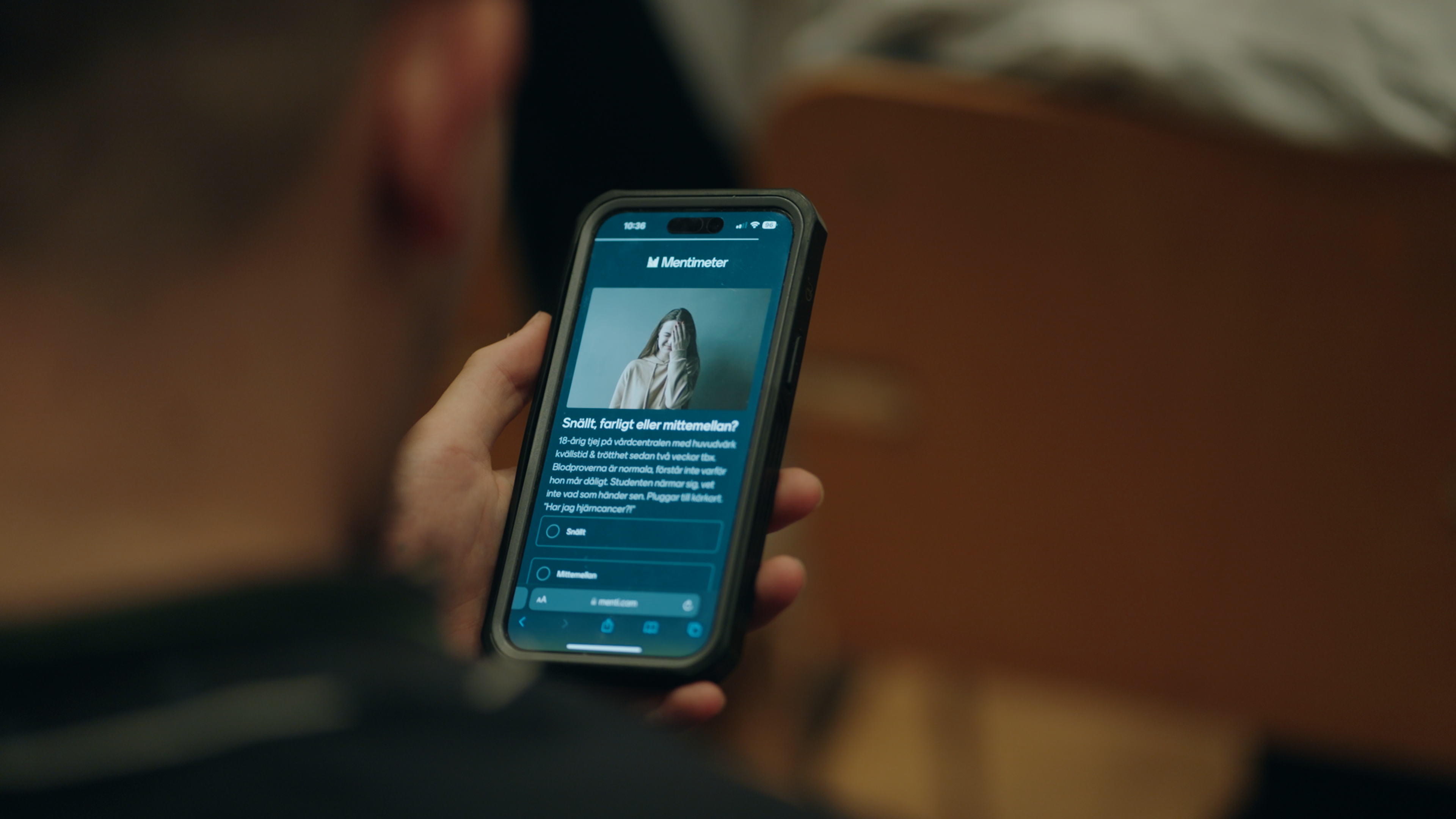
The most powerful moment comes when students are asked to take on the role of a doctor. They're presented with a case: a 16-year-old boy, chest pressure, difficulty breathing, high pulse. He plays football and was just dumped by his girlfriend. Is this dangerous or not? Most assume a heart attack. The answer is anxiety. In a single vote, the connection between physical symptoms and mental health becomes visceral and real. Not a slide to be read, but a truth to be felt.

In 2025, Efraim's work was recognized with two national awards in Sweden:
Årets Eldsjäl (Enthusiast of the Year)
Årets Stjärnskott (Rising Star of the Year)
The recognition reflects momentum, not a milestone. Efraim is now working to embed Snacka om sjukt! into school curricula at a municipal level, and has partnered with the Tim Berling Foundation to develop scalable workshop materials, complete with videos, interactive content, and Mentimeter, that schools can run independently.
Mentimeter's customer success team continues to support him in integrating the tool meaningfully as the programme grows. What started as one doctor asking a simple question, “how are you, really?”, is becoming part of how Sweden talks to its young people about mental health.
As a specialist in general medicine, Efraim Jovlunden spent years seeing young patients whose physical complaints, such as headaches, chest tightness, exhaustion, had no physical cause. The culprit, time and again, was stress and anxiety. Having experienced both himself as a student, he recognized something that clinical appointments alone couldn't fix: these young people simply didn't have the language or understanding to make sense of what they were feeling.
So he did something about it. He founded Snacka om sjukt! (loosely translated as "Talk about sickness") with a single animating question: how do you get young people to genuinely engage with mental health? His answer was to make it impossible to ignore. By blending humour, music, competitions, and video with serious medical education, he created a format that students describe as the best thing they did in school.
Just two years in, the numbers speak for themselves. Over 50,000 attendees. Overwhelmingly positive feedback. And six students who have reached out to say the lecture likely saved their lives.
Mentimeter has been part of Snacka om sjukt! from the very beginning. Efraim was already familiar with the tool from his time as a university lecturer, and it fit naturally into what he was trying to build: lectures that don't lecture, but instead invite the audience in.
With up to 1,000 students in the room, the challenge is always to make everyone feel seen, not just the ones willing to raise a hand. He opens with something deliberately light: are you team Pepsi or team Coca-Cola? Students vote with their mobiles in the Menti, cheer for their side, and the energy shifts. What was a passive audience becomes a room full of participants. The serious work can now begin.

As the lecture progresses, Mentimeter shapes the direction of the content. A word cloud reveals which disease students fear most. Cancer almost always dominates the screen, and Efraim follows their lead, making the audience feel like co-authors of the session rather than recipients of a presentation.
The most powerful moment comes when students are asked to take on the role of a doctor. They're presented with a case: a 16-year-old boy, chest pressure, difficulty breathing, high pulse. He plays football and was just dumped by his girlfriend. Is this dangerous or not? Most assume a heart attack. The answer is anxiety. In a single vote, the connection between physical symptoms and mental health becomes visceral and real. Not a slide to be read, but a truth to be felt.

In 2025, Efraim's work was recognized with two national awards in Sweden:
Årets Eldsjäl (Enthusiast of the Year)
Årets Stjärnskott (Rising Star of the Year)
The recognition reflects momentum, not a milestone. Efraim is now working to embed Snacka om sjukt! into school curricula at a municipal level, and has partnered with the Tim Berling Foundation to develop scalable workshop materials, complete with videos, interactive content, and Mentimeter, that schools can run independently.
Mentimeter's customer success team continues to support him in integrating the tool meaningfully as the programme grows. What started as one doctor asking a simple question, “how are you, really?”, is becoming part of how Sweden talks to its young people about mental health.