

Asking well-structured, open-ended questions helps us draw out thoughtful opinions and perspectives from individuals and groups. This skill is especially important for leaders seeking to create an open culture that focuses on both coaching and support, but it’s an ability anyone can develop.
The benefit of open-ended questions is that they do more for you than just gathering simple answers — they also let the recipient delve deep with their responses and voice what is on their mind. Whether you’re in a business setting, an educational one, or simply having a coffee chat, open-ended questions will get you the answers you seek.
What is an open-ended question, and why are they important?
What are open-ended questions? They are questions that start with “why,” “how,” or “what,” encouraging a full answer rather than a simple “yes” or “no.” Think of it this way: open-ended questions are for gathering insights rather than just answers.
Why are open-ended questions important? Here are a few reasons:
- They encourage longer and more detailed responses.
- They prompt respondents to take extra time to consider the question and how to answer it.
- They can also be a nice complement to data-driven survey questions, collecting additional context into aggregated answers.
Imagine you want to understand why a team member is struggling to complete an assignment. You could ask, “Do you need help?” but their one-word answer won’t give you much to work with. Instead, try asking, “What help can I offer to ensure this project gets completed by the deadline?” That will prompt your report to think through an answer, providing you with much more context.
Open-ended vs. closed-ended questions
There are times it makes sense to ask open-ended questions, scenarios where closed-ended questions are best, and times where the two types work well in combination. Not every question needs a long and detailed response, while others don’t require a great deal of thinking or consideration.
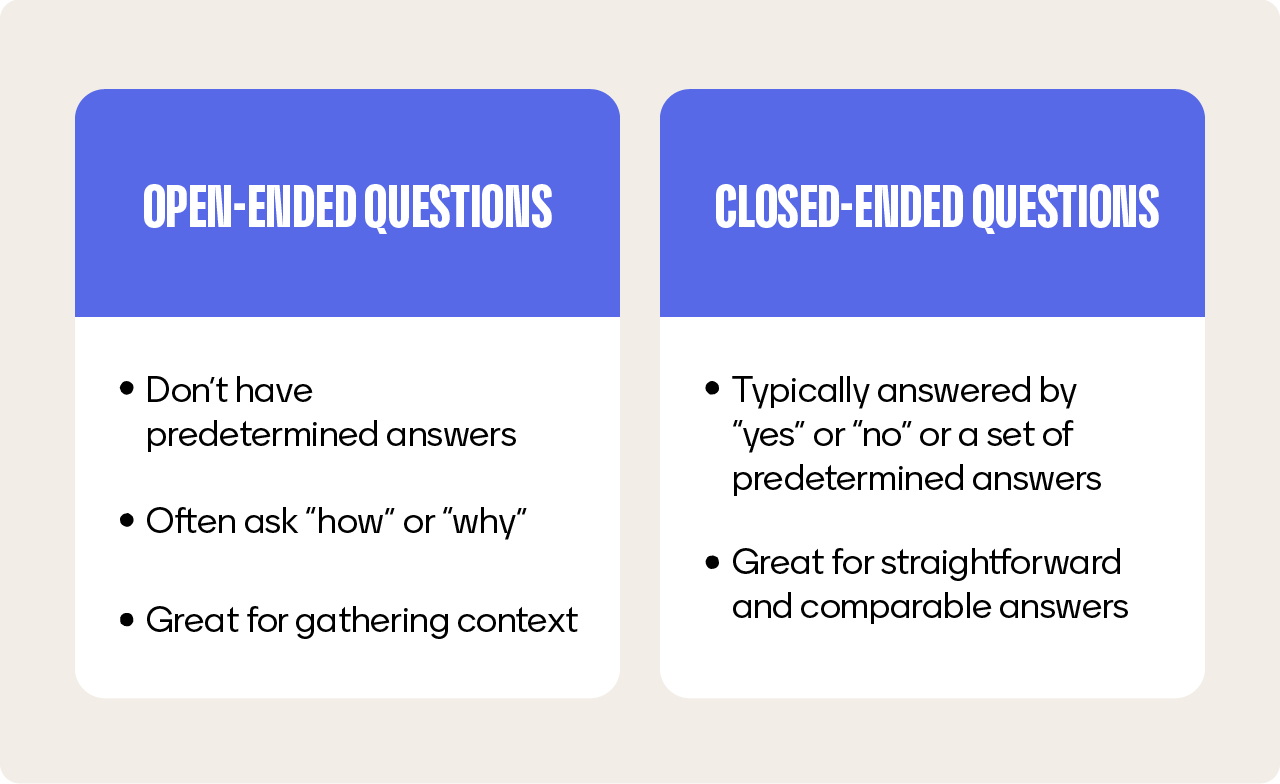
- Open-ended questions don’t have set or predetermined answers. They require a more detailed response, often seeking insight by asking “how,” “why,” or “what.” They’re best used when you need to gather context and understanding.
- Closed-ended questions are answered simply with “yes” or “no.” Alternatively, they might include a series of predetermined responses from which to choose, like Option A, B, C, and D, for example. Ask them when you need a simple, straightforward answer.
Open-ended questions are effective in both live settings and self-paced surveys. Including these types of questions in employee surveys can help you get background information as to why responses look the way they do and why trends may be appearing. In a live setting, they are great when you want to kickstart a debate or discussion.
Examples of open-ended and closed-ended questions
Effective communication requires knowing when to use open-ended questions and when a closed-ended question will suffice. Sometimes, you may start with a closed-ended question and then transition into an open-ended one to get more detail.
You also might find yourself turning a closed-ended question into something more open-ended altogether. Do this by considering the information you want to glean, then rephrasing your initial question to ask for more details. For example, instead of asking, “Did you complete the training?” (a closed-ended question), you could ask, “What did you learn from the training?”
The table below provides additional examples and suggestions for transforming a closed-ended question into an open-ended one.
| Open-ended questions | Closed-ended questions |
|---|---|
| How has the project been going? | Are you finished with the project? |
| What feedback do you have about your new manager? | Do you like your new boss? |
| What questions do you have about the required reading? | Have you finished the required reading? |
Open-ended questions examples
Asking quality questions takes practice, but there are plenty of opportunities to try it out wherever you are.
Take a look at this list of open-ended questions for inspiration to get started.
Open-ended questions for team meetings
Team meetings are a great place to leverage open-ended questions to foster lively discussions. Another way to use these questions is in post-meeting surveys, which lets you learn what your team thinks.
- How do you think we could improve these meetings?
- What do you think are the best and worst parts of these meetings, and why?
- If you were to run a meeting in the future, what would you do?
- What does a good team meeting consist of?
- How would you compare our team meetings to others at the company?

Open-ended questions for company surveys
Surveys aren’t just for team meetings — they’re a valuable tool to help you keep a pulse on the entire organization. Whether you want to learn about employee sentiment, track engagement, or simply seek feedback, there are open-ended questions to ask.
- How would you describe our working culture?
- What would you do to improve productivity?
- What would you think if we moved to a four-day working week?
- How would you feel if we were to change our benefits package?
- What could we do to improve employee retention?

Open-ended questions for brainstorming sessions
Brainstorming is a great way to share new ideas, find creative solutions, and foster collaboration. You can make brainstorming sessions even more engaging with fun, open-ended questions.
- How would you approach this problem?
- What do you think is the best solution?
- What is the best way to gather ideas?
- How do you feel about our current ways of working?
- What are the most important things when it comes to brainstorming?

Open-ended questions for classroom discussions
Another place open-ended questions shine is in the classroom. Since everyone is together to learn, it makes sense to bolster that knowledge with questions that foster thoughtfulness and lively discussions. Here are a few open-ended question examples for students:
- How would you describe school to others?
- What would you do if you were a teacher for a day?
- If you could study only one subject, what would you pick and why?
- How could we improve the school day?
- Should school be five days per week, and why?

Open-ended questions to ask leaders
Questions aren’t just meant to flow downward. They’re also crucial to ask of leaders, whether in one-on-one meetings or large-scale Q&A sessions. Consider which topics the organization is curious about, then get started with these open-ended questions to ask leaders:
- What strategies are you most excited about?
- What is the most recent difficult decision you made?
- How do you foster a positive and innovative culture?
- What lessons have you learned from failure?
- How do you balance your short-term priorities with long-term vision and strategy?
How to ask open-ended questions
What separates good open-ended questions from bad ones? For starters, a genuine interest in the response and a legitimate curiosity will help you create meaningful questions. Spend time thinking about what you would like to know from your respondents.
Here are a few best practices for asking open-ended questions:
- Start with “what,” as this allows the respondent to answer without being influenced by the person asking the question.
- Phrase “why” questions mindfully to avoid triggering defensive responses. For example, instead of asking, “Why did the project fail?” you can start with your intentions and pose the question differently, like “To help us understand how to better support the team, can you share why you think we struggled with this project?”
- Don’t ask leading questions. For instance, consider the difference between “What did you think of the presentation?” and “What do you think made that such an excellent presentation?”
- Clarify open-ended questions with follow-ups.
- Customize and adjust your questions as needed, especially during a live conversation.
| Type of question | Types of insights | Example |
|---|---|---|
| Who | Identify key players, roles, or influencers. | Who on your team has been the most successful this year? |
| What | Discover details, opinions, and explanations. | What roadblocks have you encountered with this project? |
| When | Gain insight into timing and urgency. | When did you start to see a change in retention |
| Where | Understand locations, contexts, or sources. | Where do you see the biggest opportunities for expansion? |
Open-ended questions FAQ
Still have questions? Whether yours are open-ended or not, we’ve got you covered with some answers.
How can I ensure open-ended questions are not too broad?
Focus your questions on specific aspects of a topic and provide a clear context. Adjust the scope based on the group's familiarity with the subject to ensure the questions are neither too broad nor too narrow.
How can I follow up on open-ended questions?
Follow up on open-ended questions by asking for clarification or using reflective listening (repeating back their response and asking for elaboration). You can also request specific examples or experiences or ask more about the impact of a particular situation.
How can I transition from closed-ended to open-ended questions in discussions?
Start by incorporating "why," "how," and "what" into your questions. Encourage elaboration by asking follow-up questions based on initial responses to gradually shift towards a more open-ended questioning style.
How can I encourage hesitant participants to respond to open-ended questions?
Create a supportive environment that values all contributions, use icebreakers to warm up the group, and directly encourage quiet participants by asking for their opinions or experiences related to the topic.
How can I assess the effectiveness of open-ended questions?
Measure engagement levels, the depth of responses, and the diversity of ideas presented. You can also ask for post-discussion feedback to glean insights into how participants felt about the questioning approach.
Does cultural context affect open-ended questions?
Yes, cultural nuances can influence how questions are perceived and answered. Tailor your questions to be culturally sensitive and consider your audience's communication styles to ensure they are effective and respectful.
Get more from your open-ended questions with Mentimeter
Open-ended questions let you collect critical information to improve processes, foster engagement, and enhance learning opportunities. You simply need to know the right way to ask them.
It also helps to have a hassle-free way to get your questions asked and answered, and that’s where Mentimeter comes in. You can create full surveys and presentations with a minimal amount of time and effort.
With tools designed to promote interaction and engagement, how much better can your feedback process become?
Find out today — just sign up to get started.
Create your first Menti for free
Get started