L&D can’t be true business partners
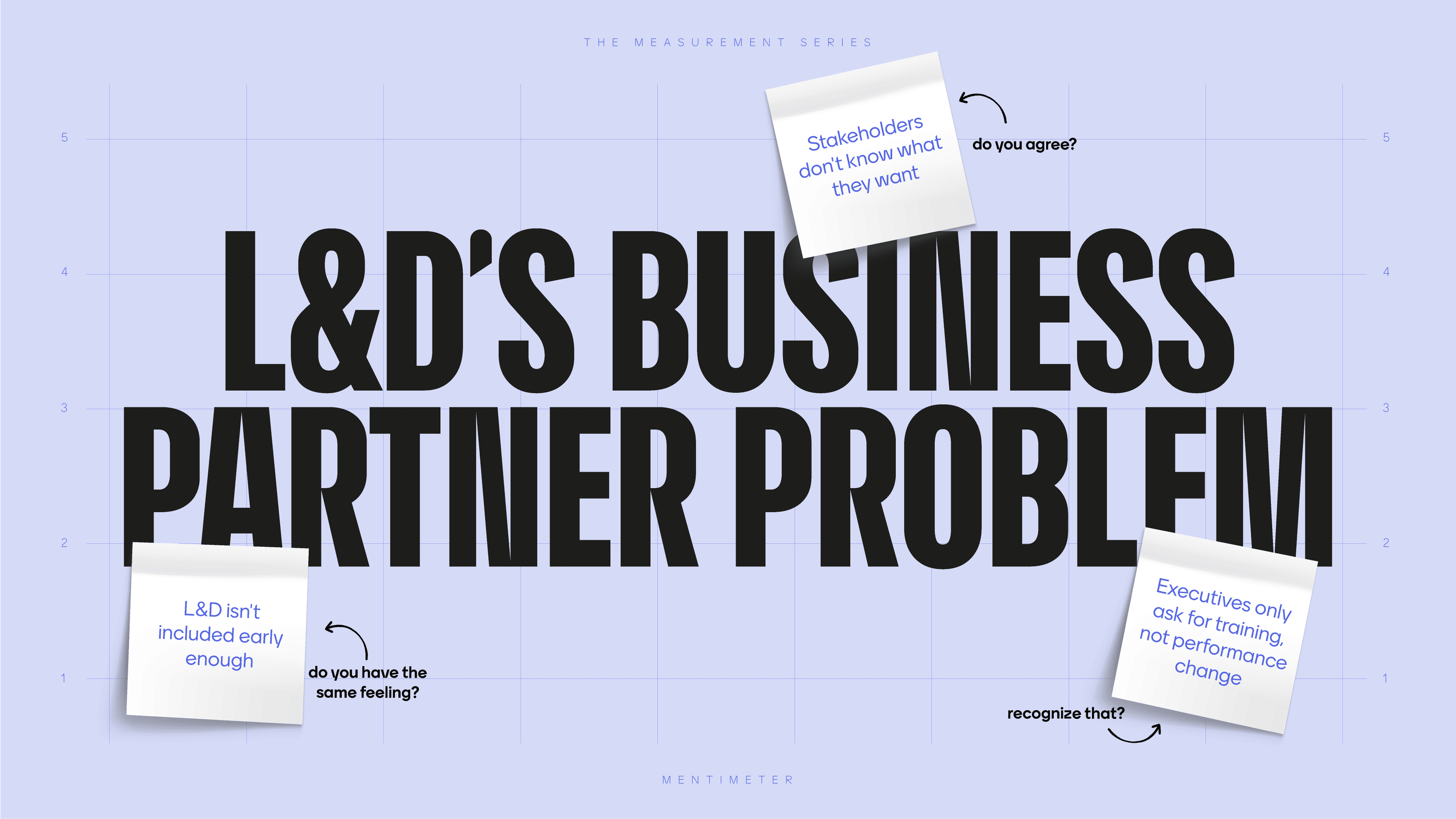

That’s something that needs to change, isn’t it? Too often, L&D are called in once the decision’s already made: “We need a training program on XYZ for 500 people.” You’re expected to prove strategic value, but rarely given the space to shape that strategy. If we want to shift how L&D is seen, we have to connect learning with real business impact. And if we want to prove real business impact, we need to improve how we measure.
The Measurement Series isn’t here to remind you that L&D needs to be given a seat at the table. It’s not going to explain why L&D should move from cost center to growth driver. If you’re reading this, you know all the Whys already.
No. The Measurement Series is going to break down how you can achieve all of the above, and it’s doing it together with an array of leading experts and authors from the L&D field, like author and Chief Learning Officer Bonnie Beresford. She shared a particularly powerful anecdote that summarizes the entire purpose of this series:
“I had one client tell me, ‘Now I’m afraid not to measure. I’m afraid not to know.’ That’s the shift we want. When leaders think of training as something they can measure, they start to take it seriously — and so does the rest of the business.”
Settle in and let’s tackle the real blockers together, starting with how to handle stakeholders and get involved early.
Part 1 Key Takeaways
- Shift from order-taker to problem-solver
L&D’s real value comes from tackling business problems, not just delivering training. Ask better questions, dig into root causes, and design for training effectiveness, not completion rates. - Redefine vague requests with smart discovery
What do you do when stakeholders ask for generic training? Turn the conversation into a training needs analysis using targeted questions and a clear brief that links learning to business outcomes. - Get involved earlier to shape the outcome
Being looped in late limits impact. Proactively build relationships with business units, speak their language, and set quarterly check-ins to ensure L&D is part of strategic planning, not an afterthought. - Reframe executive expectations with a performance lens
Leaders want results, not learning activity. Redirect solution-first requests with curiosity. Align on what success looks like and propose blended approaches that go beyond just training sessions. - Use Mentimeter to turn insights into action
From stakeholder surveys to interactive performance briefs, Mentimeter helps you ask the right questions, co-create learning solutions, and show real-time impact. It’s a practical way to move from theory to training analytics.
Or jump straight to Part 2: Because "better communication" isn't a business goal, Part 3: Think like a researcher, not a trainer, Part 4: Different problems, smarter solutions, better results, or Part 5: Learn the not-so-secret art of L&D storytelling.
From order-takers to impact makers
The real role of strategic L&D
Historically, L&D gets stuck in delivery mode. Take a request, build a course, tick the box. It keeps the wheels turning, but does it shift performance? Lori Niles puts it plainly: “We’re not here to run workshops. We’re here to solve real business problems. That starts with understanding how the business makes money, saves money, or mitigates risk—and aligning every learning initiative with that.”
Strategic L&D starts with business problems — and ends with measurable results. It means asking better questions, designing broader solutions, and proving the impact in terms the business understands using training metrics.
As L&D Detective® Kevin M. Yates says:
“*Today’s L&*D are performance consultants first, and L&D practitioners second. The shift happens when we stop asking, ‘What training do you need?’ and start asking, ‘What contributions can we make that empower business and human performance?’”
This shift reframes our value. Now you’re not just delivering training. You’re solving problems. You’re driving change.
Why this shift matters now
Both the way we work and the skills we need to thrive are changing fast. L&D leaders are facing a new set of learning and development challenges, adding pressure to deliver real impact on top of learning.
- AI and automation are changing skill requirements faster than ever
- Remote and hybrid work demands new approaches to performance support
- Economic uncertainty requires every investment to show learning ROI
- Stakeholder expectations have evolved. Executives want results, not just activity
You’re not here just to run workshops. You’re here to solve problems. And it doesn’t take a 6-week analysis to get started.
Give yourself 20 minutes with one stakeholder.
Use it to unpack the ask, find the friction, and frame what success really means. That one conversation is the first move from order-taker to partner.
Barrier 1: "Stakeholders don't know what they want"
The challenge: Vague requests
Unclear asks like “We need time management training” or “Train the sales team on leadership” are everywhere. How often have they landed in your inbox?
More often than not, right? We know. Requests that skip past the root cause are nearly impossible to design effective interventions for, let alone measure meaningful impact with training evaluation tools..
Why this happens
- Order-taker culture: Historically, L&D has been treated as a support function that executes requests without questioning
- Stakeholder assumptions: Business leaders often default to "training" as the solution without diagnosing the root cause.
- Lack of business language: L&D professionals may not ask probing needs assessment questions that uncover true business needs
Derek Mitchell has been there:
“When faced with a vague request, practitioners should use a tool like roihelp.gallusingight.com to refine the problem and craft a clear measurement strategy. If they find the questions difficult to answer, or can’t answer them at all, it’s a clear signal they don’t yet understand the problem and need to revisit the conversation with their stakeholder.”

The solution: Become a performance detective
Start with smart discovery, not assumptions to turn every training request into a performance conversation. Bonnie Beresford has seen it all too often: “When someone says they want to increase sales, we dig deeper. Is it food quality? The service staff? Maybe the wine pairings? You can’t just say 'increase revenue' — you need to pinpoint the behaviors that lead to that result. That’s what we train for.”
Essential discovery questions:
- "What business problem or opportunity is prompting this request?"
- "What would success look like in measurable terms?"
- "What evidence do you have of the current performance gap?"
- "What's been tried so far, and what worked or didn't work?"
- "Who specifically is affected, and are they aware of the expectations?"
Practical implementation:
Derek Mitchell advises that if ”there is no clear metric identified upfront, the greatest value an L&D team can provide is simply to say “No.” Then, they should quantify what the proposed solution would have cost had it gone ahead. Nine times out of ten, that cost avoidance is the true value they’ve delivered.”
You can also:
- Create a standardized stakeholder interview guide
- Use the phrase "Yes, and..." to redirect without rejecting: "Yes, we can help with that—and to ensure it delivers results, let me understand the situation better"
- Document findings in a "performance brief" that both parties sign off on
Example reframe:
- Before: "We need customer service training"
- After: "We need to reduce customer complaint escalations by 30% within 6 months by improving frontline problem-solving capabilities"
When stakeholders aren’t sure what they need, your job isn’t to fill in the blanks, it’s to ask the right questions and uncover what really matters. And if you find yourself intimidated by challenging them, take this piece of advice from Bonnie Beresford with you:
*“*If stakeholders get uncomfortable with those questions? That’s okay. They’re about to invest in training — don’t they want to know it’ll work?”

Barrier 2: "L&D isn't included early enough"
The challenge: Last minute requests
Many L&D teams aren’t looped in until the decisions have already been made. Cue the scramble. With no time to influence the approach, measure impact, or align with broader strategic goals, your role is reduced to damage control.
Why this happens
- Historical positioning: L&D has been viewed as a support function, not a strategic partner
- Language barriers: L&D professionals who focus on learning metrics rather than business metrics get excluded from strategic conversations
- Reactive relationships: Without proactive outreach, L&D only gets involved when problems become urgent
Pro tip from Kevin M. Yates:
“When I’m brought in late and given a request like ‘we need leadership training,’ I see it as an opportunity, not an obstacle. I respond with curiosity while staying focused on performance. I might respond with something like, ‘Before we talk about training, can you share what the performance expectations are for leaders and the evidence that shows the gap between where performance is and where it needs to be?’, or ‘How do you describe where manager performance is versus where it needs to be?’. My goal is partnership, not push-back. That’s how we move from fulfilling a training request to creating opportunities for addressing real performance needs.”
The solution: Integrate into business rhythm
To make learning impact stick, it needs to move beyond one-off reports or afterthoughts. The real shift happens when L&D becomes part of the business rhythm, i.e. woven into how teams set goals, make decisions, and measure progress. As Bonnie Beresford puts it, the key is inviting stakeholders in early, not to approve content, but to help define what success actually looks like. That shared ownership makes all the difference. “When L&D brings business stakeholders into the room, you don’t just get buy-in. You get access to the right data, you define success together, and — here’s the kicker — they start taking responsibility for the outcome.”
But how do you actually make that happen? Here are a few practical ways to embed learning impact into the everyday rhythm of the business.

Establish quarterly alignment sessions with each major business unit:
- "What are your upcoming goals and challenges for next quarter?"
- "What capabilities will your teams need to achieve those goals?"
- "Where are you seeing performance gaps that might impact results?"
Speak business language:
Start using performance-focused phrasing and metrics grounded in corporate training costs or productivity. Lori Niles emphasizes: “Learning objectives are important to L&D. The business doesn’t care. They want impact. They want to know if this moved a metric that matters.”
- Instead of: "We're planning leadership training for Q3"
- Say: "We're focusing on reducing manufacturing error rates by 20% through improved supervisor decision-making"
Reposition your role:
Shift from “training provider" to strategic adviser using models like the Kirkpatrick model.
- Change your elevator pitch from "I run training programs" to "I solve human performance problems that impact business results"
- Consider rebranding your team (e.g., "Performance Improvement," "Talent Strategy")
- Develop consulting skills within your team
Build strategic credibility:
- Come to meetings with basic understanding of each unit's performance data
- Present L&D impact in business terms: "Our last sales enablement program lifted quarterly revenue by 15%"
- Offer solutions beyond training when appropriate
Getting involved earlier isn’t just about timing, it’s your chance to shape the solution instead of just delivering it.
Barrier 3: "Executives only ask for training, not performance change"
The challenge: Jumping straight to the solution
Senior leaders come with solutions, not problems for L&D to solve. “We need a quick productivity training program for the team." But if we don’t identify with what’s not working, we can’t build what actually solves it or measure meaningful business outcomes.
Over the course of his career, author of “High impact Learning” Robert Brinkerhoff has often found himself in this situation. He shared that the best question he’s asked was “Imagine that we do this training and it works amazingly well – gets superb results. What’s different? What do you have after this training that you don’t have now? “ Use active listening to understand what you are hearing. Ask follow-up questions to confirm your understanding.”
Why this happens
- Training as quick fix: Executives under pressure want visible, immediate action
- Limited solution awareness: Many leaders aren't familiar with non-training performance interventions
- Traditional expectations: Training is what people expect L&D to provide
The solution: Translate requests into performance outcomes
It’s your job to lead your stakeholders through the process of identifying the problem, even if they already think they’ve found the solution. Use performance-first discovery to inform action mapping and design effective interventions. The key is to shift the conversation from “what training do we need?” to “what change are we trying to make?”
An example on how to do this from Kevin M. Yates is to ask “ 'Is there a key performance indicator that monitors the business goal and if so, who owns it?', and 'What are the skills, capabilities, actions, and behaviors needed to achieve the business goal?'. These questions don’t challenge stakeholders, but they do trigger a performance-first mindset. And they shift the focus from training activity to performance outcomes that matter.”

Another piece of advice from Julie Trell is to ask curious and non-leading questions.
“I often use anonymous surveys that mix quantitative and qualitative questions, with a strong focus on storytelling. Some of the examples of questions I ask are:
- Describe a situation where you found it CHALLENGING to have a difficult conversation. Consider including what obstacles made it CHALLENGING?
- Share an example where your team had to overcome a significant obstacle. What strategies did you employ?
- Describe a time when you successfully influenced a decision or outcome. What strategies did you use?
- Share a time when curiosity or a playful approach led to a breakthrough or creative solution in your work
It's all about creating a safe space for stakeholders to share their stories from these questions, so we can uncover the true business goals together.
Here’s are even more steps you can take to make that shift:
Use tactful reframing:
- "Sure, we can help with that. Let's clarify what specific change you’re hoping to see from this training?"
- "When you say training, are you open to other approaches that might achieve that outcome more effectively?"
Challenge assumptions diplomatically:
- Share relevant data: "In similar situations, we've found that 70% of performance gaps are caused by factors other than knowledge—such as unclear processes or lack of feedback"
- Offer evidence: "Last year, we discovered that redesigning the workflow eliminated the problem before training was even needed"
Expand the conversation:
- Don't say no to training—expand the scope: "Yes, and to make sure it delivers the results you want, let's explore what else might be needed"
- Present comprehensive solutions: training + job aids + manager coaching + process improvements
Set performance expectations:
- "If we move forward with training, what would be the indicators six months from now that it worked?"
- "Let's define success in business terms so we can measure our impact"
When leaders ask for training, it’s your cue to dig deeper. Behind every request is a performance goal and it’s your job to uncover it. Bonnie Beresford puts it simply: “If they can’t say what they expect people to do differently after the training, they’re not ready for training. Our job is to get specific — down to individual behaviors. That’s how you avoid delivering the wrong course.”

Your performance alignment checklist
You don’t need to run this checklist over three meetings.
You need one 20-minute session where you ask the right questions.
If the answers are clear: move. If not: pause. Don’t design anything until you’re aligned.
1. Problem definition
- Do you have a clear performance brief that describes the business problem, not just the training topic?
- Can you pinpoint the behaviors that need to shift to reach the desired business outcome?
2. Success metrics
- Are there specific business metrics tied to this initiative (like sales increase, onboarding metrics, error reduction, or customer satisfaction improvement)?
- Have stakeholders agreed on what success looks like – and how it’ll be measured?
3. Strategic alignment
- Were you in the room early, not just called in to deliver?
- Does this work ladder up to a real business priority and not just a nice-to-have?
4. Comprehensive solution design
- Is your solution bigger than a course? Think: performance support, manager nudges, or system tweaks.
- Have you tackled the barriers to behavior change beyond just filling knowledge gaps?
5. Impact measurement
- Do you have a plan to show progress in business terms, not just participation rates?
- Are you tracking both early signals (behavior change) and bottom-line results?
If you’re ticking these boxes, you’re not just training – you’re changing how things work.

Making the shift: next steps
You don’t have to overhaul everything overnight. Start small and think big to build momentum one smart move at a time.
Pick your pilot
- Apply this framework to one upcoming project
- Use it to deepen one key stakeholder relationship
- Capture and share success stories to build trust
Sharpen your consulting skills
- Practice discovery questions in low-stakes situations
- Learn the basics of business metrics and what they mean
- Partner up with analytics teams to strengthen your measurement game
Change how you talk about your work
- Say “performance improvement” instead of “training”
- Frame initiatives around outcomes, not activities
- Speak their language: KPIs, metrics, and business goals
Build tools that scale
- Draft reusable templates for stakeholder interviews
- Design a simple, repeatable performance brief
- Set up measurement frameworks you can pull out anytime
Every shift you make helps move L&D from order-taker to strategic partner. Keep going, it adds up.
The real payoff
When L&D shows up as a performance partner and not just a training provider, everything changes.
- Stakeholders start seeing L&D as a strategic ally, not a support function
- Budget conversations shift from defending costs to providing ROI
- Credibility increases, unlocking new career growth opportunities and influence
- Impact visibility increases because you’re speaking in business results, not just completions
And here’s the kicker: organizations that embed L&D into strategic planning are 46% more likely* to lead their industry. This isn’t just about better courses. It’s about building a better business, one smart performance at a time.
Related resources
Want to go from theory to action? Stay tuned to the Measurement Series for more tools like these:
- How to quickly run stakeholder interviews for impact-driven L&D - Step-by-step guide with templates
- Setting up experiments to measure training effectiveness - Practical measurement frameworks
- Designing learning experiences that drive performance - Beyond traditional training approaches
Ready to get started? Download our Stakeholder Interview Template, Alignment Pulse Check, and Performance Brief Framework to turn your next L&D request into a strategic performance win.
* Brandon Hall Group – “The Strategic Importance of Learning and Development in Modern Organizations”: https://www.c-suite-strategy.com/blog/the-strategic-importance-of-learning-and-development-in-modern-organizations
Erstellen Sie Ihr erstes Menti kostenlos
Legen Sie los

